

Tenant Login: Easy Access to Your Tenant Portal
Effortlessly manage your lease with our Tenant Login Guide. Learn about tenant login essentials, from portal access to your tenant dashboard.
6 min read

Lease termination in Texas comes down to three things: the lease language, the type of tenancy, and the reason one side wants the lease to end. For landlords, the safest approach is to document every notice, follow the written lease agreement and Texas requirements you agreed to, and know when state law gives a tenant special rights to leave early. This guide explains the practical side of lease endings so you can reduce disputes, protect cash flow, and treat tenants fairly.
Lease termination means the legal rental relationship is ending, either because the lease term is over, one party gives proper notice, both sides agree to end it, or the law allows early termination. In Texas, a lease may be written or oral, and the Texas State Law Library notes that the Property Code defines a lease broadly as an agreement that sets or changes the terms for using and occupying a dwelling. (guides.sll.texas.gov)
For a landlord, termination is not the same thing as eviction. Termination says, “This rental agreement is ending.” Eviction is the court process used when someone does not leave after the legal right to possession has ended. Mixing those up is one of the fastest ways new landlords create avoidable legal problems.
A clean termination file should show what lease applies, when notice was delivered, what date the lease ends, what money is owed, and how the security deposit will be handled. That sounds basic, but in property management, basic paperwork wins a lot of arguments before they ever start.
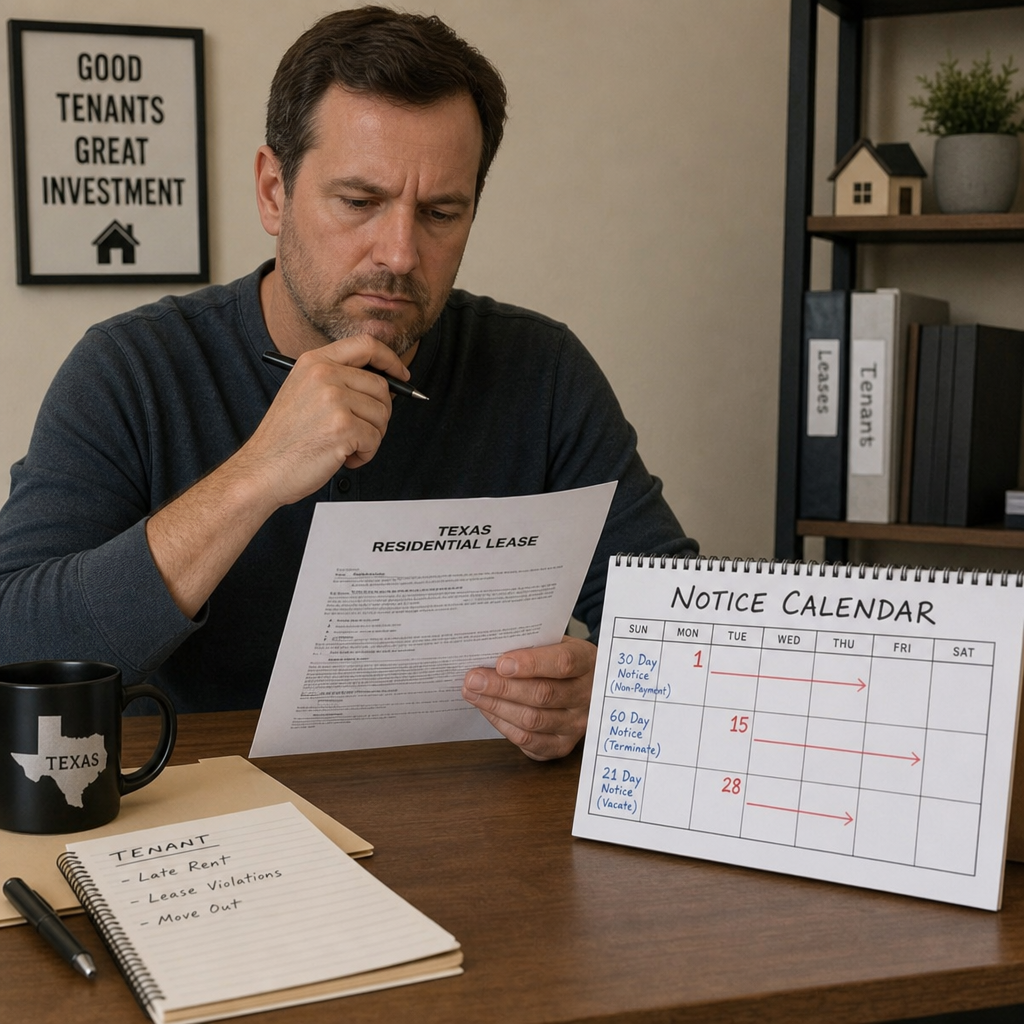
The first place to look is always the lease. A good Texas lease should explain the lease term, renewal rules, move-out notice, early termination fees if any, reletting charges if any, property condition duties, and how notices must be delivered. If your lease is vague, you may still have state law to fall back on, but vague documents leave more room for disagreement.
For fixed-term leases, such as a 12-month agreement, the tenant generally has the right to stay through the end of the lease if they follow the agreement. A landlord usually cannot end a fixed-term lease early just because they want to sell, raise rent, or place a different tenant. If the tenant violates the lease, that is different, but you still need to follow the notice and eviction rules.
For month-to-month tenancies, Texas Property Code Section 91.001 allows either the landlord or tenant to terminate by giving notice. If rent is paid monthly, the tenancy ends on the later of the termination date stated in the notice or one month after notice is given, unless the parties signed an agreement with a different notice rule. (statutes.capitol.texas.gov) Learn more about understanding lease termination laws in Texas.
Most lease endings are routine. Trouble usually starts when one side assumes the other “should have known” what was expected. Put the ending in writing, even when the conversation was friendly.
Common lease-ending situations include:
From an operator’s standpoint, mutual agreements are often underrated. If a tenant truly needs out, a written move-out agreement can be cleaner than months of partial payments, conflict, vacancy uncertainty, and collection headaches.
A tenant may be able to leave early without ordinary lease-breaking liability when a Texas statute gives them that right, and they follow the required steps. This is where landlords need to slow down, read the notice carefully, and avoid treating every early move-out as a standard default.
Texas law includes early termination protections for certain tenants affected by family violence, certain sexual offenses or stalking, military service, death of a sole tenant, and some serious repair issues. The details matter. These laws often require written notice and supporting documentation, and some rights cannot be waived by lease language. (tcss.legis.texas.gov)
Texas Property Code Section 92.016 covers certain family violence situations, and Section 92.0161 covers certain sexual offenses, stalking, and related circumstances. Section 92.017 addresses early termination connected to military service. If you receive one of these notices, handle it with privacy, professionalism, and a careful review of the required documents. (tcss.legis.texas.gov)
The practical landlord move is simple: do not argue from emotion. Confirm the statute cited, confirm the documents required, document the move-out date, and update your accounting. If the situation is sensitive, limit internal discussion to people who truly need to know.
Texas tenants also have repair rights when a condition materially affects the physical health or safety of an ordinary tenant and the statutory process is followed. The Texas Attorney General explains that, after proper notice and if the landlord still has not made diligent repair efforts within a reasonable time, a tenant may be entitled to terminate the lease, repair and deduct, or seek a court order. (oag.state.tx.us)
For landlords, this is a reminder that maintenance is not just customer service. It is risk control. Keep repair requests, vendor notes, photos, invoices, access attempts, and tenant communications in one place.
Breaking a Lease in Texas without a legal excuse usually means the tenant may remain responsible for rent and other lawful charges under the lease, but the landlord must still act reasonably to reduce the loss. Texas Property Code Section 91.006 says a landlord has a duty to mitigate damages if a tenant abandons the leased premises in violation of the lease. (tcss.legis.texas.gov)
In plain English, you cannot just let the property sit empty for months and expect the old tenant to pay while you make no effort to re-rent. You should advertise, show the property, process applicants, and document those efforts. This protects your claim if you later seek unpaid rent or other damages.
A practical lease-break workflow looks like this:
If a tenant defaults or holds over, Texas law generally requires a written notice to vacate before the landlord files an eviction suit. Texas Property Code Chapter 24 states that a landlord must give at least three days’ written notice to vacate before filing a forcible detainer case, unless a written lease provides a shorter or longer period. (tcss.legis.texas.gov)
This is where many new landlords get impatient. Do not change locks, remove belongings, shut off utilities, or pressure a tenant out outside the legal process. Even when the tenant is clearly wrong, self-help tactics can turn a good case into an expensive problem.
Your notice should match the lease and the facts. A nonpayment notice, holdover notice, and lease-violation notice may not read the same way. If your forms are old, copied from the internet, or borrowed from another state, update them before you need them.
Lease termination does not erase security deposit rules. The Texas Attorney General states that landlords must return the deposit, minus lawful deductions, within 30 days, and if money is withheld, the landlord must provide an itemized list of deductions with a description of damages. The landlord may not charge for normal wear and tear, only actual abnormal damage. (texasattorneygeneral.gov)
Good deposit handling is part law, part communication. Take move-in photos, use a written condition form, keep receipts, and avoid vague charges like “cleaning” without detail. If you cannot explain a charge in one clear sentence and back it up with evidence, reconsider it.
Use this checklist before you send a termination notice, accept an early move-out, or file for eviction:
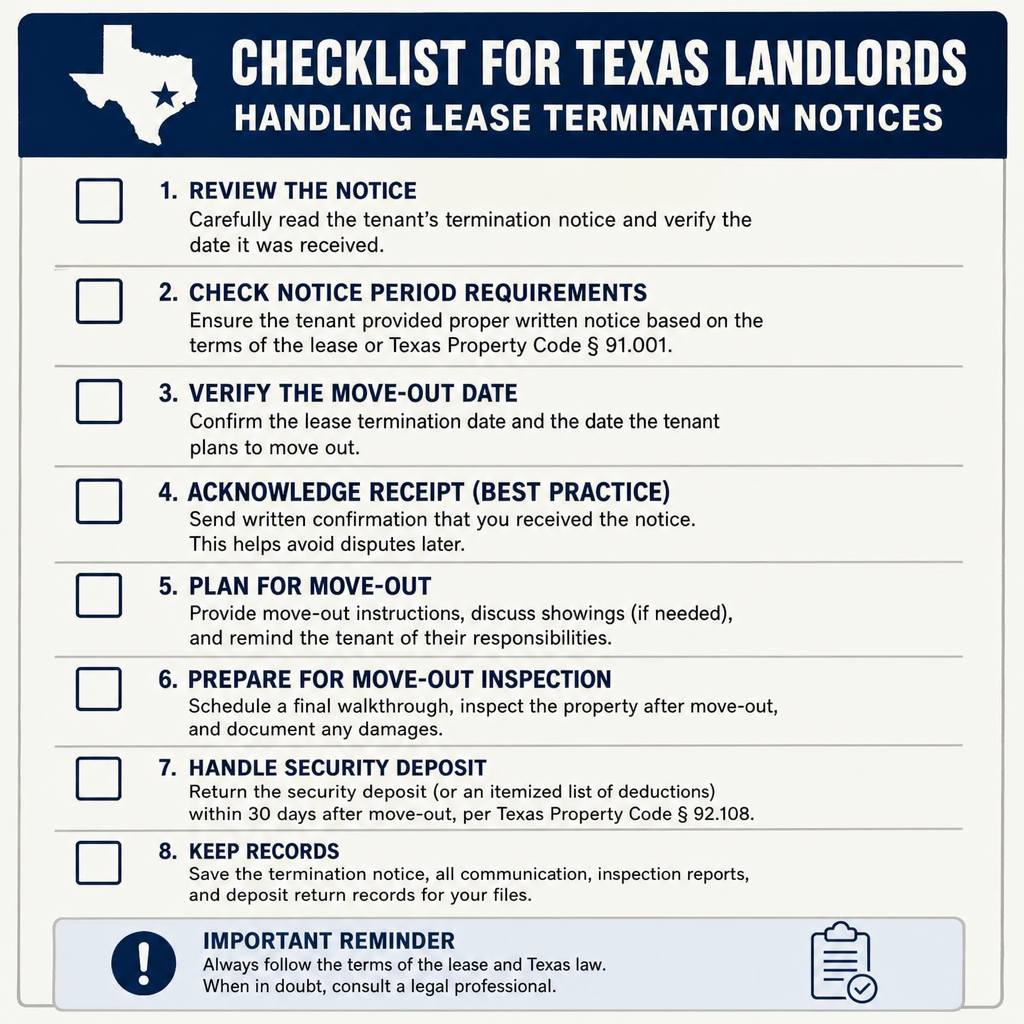
The best lease termination strategy starts before you sign the lease. Use a strong lease, explain the move-out process at onboarding, and keep your tenant ledger clean. Investors sometimes focus only on acquisition numbers, but sloppy lease administration can quietly eat returns through vacancy loss, legal fees, and preventable disputes. For more detailed insights on managing rental agreements, read our guide on property management best practices.
For property management professionals, consistency is the secret. The same violation should trigger the same process across your portfolio, subject to fair housing rules and the specific facts. When your team uses standard templates, clear approval steps, and documented communication, you reduce mistakes and make owner reporting much easier.
Also, stay personable. A tenant leaving under stress may still cooperate if you are clear and respectful. You can be firm about the lease while still treating people like adults.
Lease termination laws can feel complicated, but the working rule is straightforward: read the lease, follow Texas law, document everything, and do not improvise when possession or money is on the line.
If you manage property in North Texas and want practical guidance from a team that deals with leases and tenant issues every day
Call (214) 305-9166 for a free consultation.
You can also visit https://nmcpropertymanagement.com/ for property management support,
Watch video guides at https://www.youtube.com/@NorthTexasPropertyManagement/

Effortlessly manage your lease with our Tenant Login Guide. Learn about tenant login essentials, from portal access to your tenant dashboard.
Unlock the potential of your investment with expert Plano Property Management and Related Services. Discover disciplined strategies for real estate...

Learn how lease breaking affects credit in Dallas County, Texas. Understand key impacts on your credit score and rent-based credit building.